Rhythm is the heartbeat of music. It’s what makes us tap our feet, dance, or feel the pulse of a song—even when there’s no melody or harmony playing.
In music theory, rhythm refers to the timing of sounds and silences. It’s how long or short notes are played, how they’re grouped together, and how they’re organized within a piece of music. At the foundation of rhythm are beats—the regular, repeating pulses you can count along with. These beats are organized into measures (or bars) and follow a set pattern called a time signature.
Rhythm also involves note values (like whole notes, quarter notes, and eighth notes), rests (periods of silence), and patterns such as syncopation (emphasizing off-beats) or polyrhythms (layering different rhythms at once). These elements combine to create grooves, feels, and energy in music.
Whether it’s the driving rhythm of a rock song or the subtle swing of a jazz piece, rhythm gives music its forward motion and sense of time. It’s what turns a series of notes into a living, moving experience.
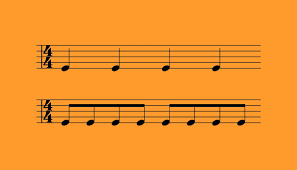
This image shows two different rhythms for a 4/4 time signature: (4) quarter notes, and (8) eighth notes.