Major and Minor Scales
Major Scales
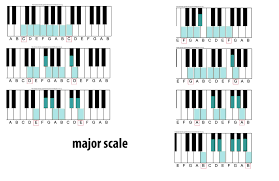
A major scale is a series of notes that follow a specific pattern of whole steps (2 half steps) and half steps (1 half step). It’s the foundation of Western music and gives a happy, bright sound. On the piano, a major scale is made up of eight notes: the first and last notes are the same, but the last one is an octave higher. The formula for a major scale is: Whole – Whole – Half – Whole – Whole – Whole – Half. This pattern stays the same no matter what note you start on.
Let’s take the C major scale as an example, which is the easiest one for beginners because it uses only white keys. The notes are: C – D – E – F – G – A – B – C. If you look at the keys, you’ll see that this pattern follows the major scale formula exactly. Starting from C, you go up a whole step to D, another whole step to E, a half step to F, then whole steps to G, A, and B, and finally a half step back to C.
Each major scale has a different combination of black and white keys, depending on the starting note. For example, the G major scale has one sharp (F♯): G – A – B – C – D – E – F♯ – G. The pattern is still the same; only the notes change to fit the major scale formula.
Learning major scales helps you understand key signatures, build chords, and improve finger coordination on the piano. Most songs are based on a major or minor scale, so knowing your major scales is a big step toward becoming a better player.
Minor Scales
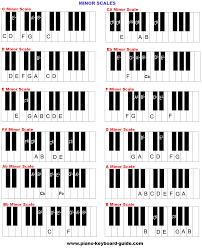
A minor scale has a darker, sadder, or more emotional sound compared to a major scale. Like major scales, minor scales have eight notes and follow a specific pattern of whole and half steps, but the pattern is different. The most common type is the natural minor scale, and its step pattern is: Whole – Half – Whole – Whole – Half – Whole – Whole. This gives it its unique, moody character.
Let’s look at the A minor scale, which is the simplest natural minor scale because it uses only white keys on the piano. The notes are: A – B – C – D – E – F – G – A. Starting on A, the scale follows the natural minor formula. You can hear right away how it sounds more somber than a C major scale, even though it uses the exact same notes—this is because the order and intervals are different.
In addition to the natural minor, there are two other forms of minor scales: the harmonic minor and the melodic minor. The harmonic minor scale raises the 7th note by a half step to create more tension. So in A harmonic minor, the notes are: A – B – C – D – E – F – G♯ – A. This raised G♯ gives it a more exotic, dramatic sound. The melodic minor scale raises both the 6th and 7th notes by a half step when going up but usually returns to the natural minor when going down. So going up, A melodic minor is: A – B – C – D – E – F♯ – G♯ – A; going down, it’s typically played as G – F – E – D – C – B – A.
Understanding minor scales helps you play songs in minor keys, build minor chords, and add emotional variety to your music. Practicing all three forms (natural, harmonic, and melodic) will give you a strong foundation for expressive piano playing.