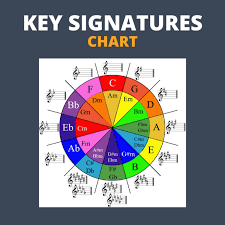
Key signatures are like road signs in sheet music—they tell you right away which notes will be sharp or flat throughout a piece. Instead of marking every accidental again and again, composers use key signatures at the beginning of each staff to set the tonal “rules” from the start.
In simple terms, a key signature shows which scale the music is based on. For example, if a piece is in G major, the key signature will have one sharp: F♯. That means every F you see in the music should be played as F♯—unless otherwise noted.
Key signatures are made up of sharps (♯) or flats (♭), and the number of them tells you what key you’re in. The more sharps or flats you see, the farther away you are from C major, which has no sharps or flats at all. Each key has its own pattern of whole and half steps, and the key signature helps maintain that pattern across the music.
Learning key signatures isn’t just about memorization—it helps you hear the music better. Once you know what key you’re in, you’ll have a better sense of which chords will appear, which notes will feel like “home,” and how melodies and harmonies are likely to move.
Whether you’re sight-reading, composing, or just trying to understand what you’re hearing, key signatures are a must-know tool for unlocking the language of music.
The picture shows the numerous key signatures as depicted in the Circle of Fifths.