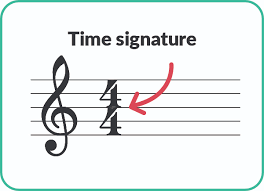
Time signatures are like the heartbeat of a piece of music—they tell you how the rhythm is organized and help you feel the pulse of the beat. Just like a recipe tells you how much of each ingredient to use, a time signature tells you how many beats are in each measure and what kind of note gets the beat.
You’ll find the time signature at the very beginning of a piece, right after the key signature. It looks like a fraction, but it’s not about math—it’s about rhythm. The top number tells you how many beats are in each measure, while the bottom number shows what kind of note counts as one beat. For example, in 4/4 time—often called common time—there are four beats per measure, and each beat is a quarter note. In 3/4 time, there are three quarter-note beats per measure, giving the music a lilting, waltz-like feel. In 6/8 time, there are six eighth-note beats in a measure, usually felt in two bigger beats, creating a flowing, dance-like rhythm.
Time signatures help musicians stay together, keep steady rhythm, and understand the groove of the music. Whether you’re clapping along, reading sheet music, or creating your own songs, the time signature is your guide to how the music moves forward.
Learning how to recognize and feel time signatures makes rhythm more natural—and music more fun to play and listen to.
The image shows the 4/4 time signature, one of the most common time signatures in music.