Harmony is one of the fundamental elements of music. While melody is the main tune you might hum or sing, harmony adds depth, richness, and emotion by supporting the melody with additional notes played or sung at the same time.
In music theory, harmony refers to the combination of different musical notes played together to produce chords, and the way these chords move from one to another. This movement is called chord progression, and it helps shape the mood and direction of a piece.
Harmony can be simple—like a single chord played under a melody—or complex, involving many layers of chords that change frequently. Understanding harmony involves learning about intervals (the distance between two notes), triads (three-note chords), seventh chords, and how chords are built from scales.
In essence, harmony is what gives music its emotional color and texture. Whether it’s the peaceful sound of a major chord or the tension of a dissonant interval, harmony helps tell the story behind the music.
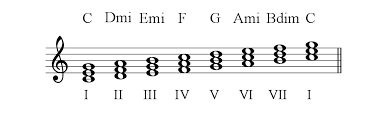
This image depicts the seven major chords of any scale, numbered I, II, III, IV, V, VI, and VII, respectively.